

The most expensive person in your company is the one nobody listens to.
This article was originally published on Linkedin.
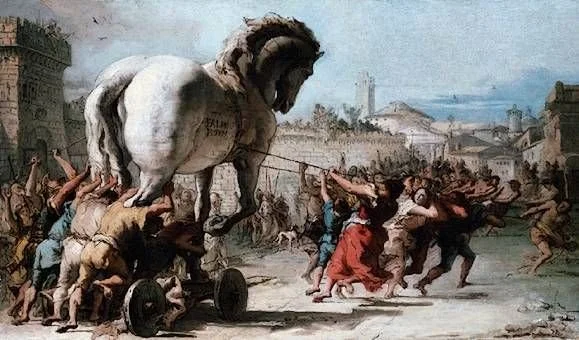
The Procession of the Trojan Horse (1760) by Giovanni Domenico Tiepolo
Cassandra saw it coming: the Greeks at the gates, the horse, the fall of Troy. She named it repeatedly and with complete accuracy, but was dismissed every time. Not because she was wrong, but because Apollo—god of truth and prophecy—gave her the gift of seeing clearly, then cursed her so that nobody would believe her.
Every organisation has a Cassandra. The junior analyst who kept flagging the churn data nobody wanted to see. The Head of People who named the cultural fracture in 3 consecutive board meetings and was thanked each time for raising it. The new hire who hasn't learned what not to say.
They are not difficult, wrong or negative Debbie Downers, but simply ahead of the room. Psychology tells us this is rarely about individual failure. When groups prioritise cohesion, they develop a collective blind spot—screening out signals that disrupt the story they've already decided to believe. Our deep preference for comfort over correction does the rest.
Cassandra's curse was not her gift, but the absence of anyone willing to receive it. Troy didn't fall because she lacked credibility. It fell because the culture had never created the conditions for an uncomfortable signal to actually land.
In our research on 500 EU scale-ups, we explored this pattern in depth. In our work, we've learned to look for the Cassandra early, because it tells you everything about the company's ability to learn. Is the signal being received? Or is it being managed, softened, and deferred until it becomes undeniable?
Why? For established companies, ignoring a Cassandra is costly. For a scale-up, it can be existential. You are still proving your product, building your reputation, earning market trust. Having a close pulse on the customer, the culture, on what's quietly going wrong are not 'nice-to-haves'. They are the early warning system that keeps you alive.
The Trojans had every warning they needed. They chose the horse anyway.
🐴
Laurie writes weekly insights on leadership and business building—drawn from art, myth and literature. Follow her or FABRIC for more.
💌 Title: The most expensive person in your company is the one nobody listens to.
🎭 Inspiration: The Iliad, Cassandra
🎨Art: The Procession of the Trojan Horse (1760) by Giovanni Domenico Tiepolo. Public domain, National Gallery, London.