
The Double Gaze: What Janus, the Roman God of thresholds, teaches us about leadership and growth.
What got you here won't get you there
In the world of start-ups and VCs, you hear it all the time: what got you here won't get you there. The maxim was popularised by executive coach Marshall Goldsmith's 2007 book of the same name. It applies to every leader who grows, but nowhere as sharply as in a fast-growing tech company. Why? Because there, growth is rarely slow or gradual. Ambitions are high, the pace is relentless, and growth capital comes with sky-high promises and optimistic hockey-stick graphs. Try keeping that up as a leader. It’s why Anna Dia sometimes jokes that at Growth Tribe she was promoted every seven months, and had to develop herself at breakneck speed just to keep up with the organisation’s growth and unfolding leadership demands.
Everyone nods when the ‘what got you here’, phrase comes up. Almost no one stops to consider what it takes to actually live it.
When a role or identity starts to chafe
What makes it so hard, in my experience, is that a company is rarely just a company. As founders, we give shape to something that did not yet exist—through hard work, sacrifice, inspiration, creativity, dedication, struggle, pain, resistance and hope. Our company is part of who we are. And the more something’s woven out of our vision, dreams, norms and values, the more something becomes part of our identity, the harder it is to distance ourselves from it. A founder identity or a start-up culture grows out of years of hard work and survival, and doesn't let itself be traded in just like that. And rightly so.
Whoever takes on a new role or enters a new space, says goodbye to an old one. Something has to die while the new is still being born. And it is precisely on that threshold, where the old no longer fits and the new is not yet tangible, that we start feeling uncomfortable.
Because however much we celebrate growth in our day and age (especially in the world of startups, tech and VC/PE investing), growing also hurts. Just think of the crab. It doesn't grow by stretching its shell, but by shedding it. Its old shell splits open and the crab crawls out. What follows is a vulnerable period: soft and unprotected, the creature looks for a place to hide until its new, larger shell has hardened.
Growth isn't only about winning and scaling. Growth is equally uncomfortable and painful. It asks us to reconsider our role, important parts of our identity, sometimes even the entire story on which we hang our existence. It asks us to let go of what we are attached to, and of what we have often sacrificed a great deal for.
The first gaze: fear
If you then focus only on the loss, on what you stand to lose, I fully understand why you would rather stay inside your ‘shell’, however much it may pinch and hurt. There is a reason most people instinctively shy away from change. Back in 1979, psychologists Daniel Kahneman and Amos Tversky showed that a loss weighs roughly twice as heavily on us as an equivalent gain.
And so fear starts to creep in. And boy is she clever, cunning even, on that threshold of change. Rarely does she announce herself as fear. Instead, she shows up as diligence, commitment or high standards. The entrepreneur still rewriting the sales deck at night. The new director who keeps doing what she did before she was promoted. The executive-turned-board member jumping into daily ops and sales negotiations. We say it’s care, responsibility, dedication. Often it is something else: the part of us that brought us here and doesn't want to be left behind.
Insight is not change
I know many founders and leaders who can name their behaviour and their fears with precision, and are still stuck. We know exactly what we should so differently, yet repeat the same behaviors the next day. Naming a fear doesn't set you in motion. Whoever focuses all their attention on the fear often gives it more room. Then, consciously or not, it becomes our hidden compass for every decision.
Desire pulls us, calls us; fear holds us back. Naming fear doesn't set you in motion.
What I often see are conflicting desires. Wanting to shift, but not being able to. Or being able to change, but being held back by something lurking in the shadows. The desire for the bigger role, for the company we envision, for who we could become. And the fear that we can't do it, that we'll become redundant, that we'll lose what made it special, or that, in a new role, we won't be able to pull it off again. And often: the more real desire becomes, the louder fear speaks, until it drowns out everything else.
In my experience, what sets us in motion is not so much naming the fear, but having something to move towards. I have worked with many founders who feel that they have done nothing but let go of ‘hats’ they wore fore years. Sooner or later, the oh so familiar voice will creep up again, saying: Do I really have to let go of even more? It feels as if that's all I've done these past years. What will still be left for me, on the other side of this?
Yet, I strongly believe is what it comes down to: the shift from fear to desire. Not by denying the fear, because then it only calls out louder, but by no longer giving it the final word. The question then shifts from What should I stop doing? and What do I have to let go of? to What do I want to bring into being? And from What am I losing? to What is calling me?
The second gaze: desire
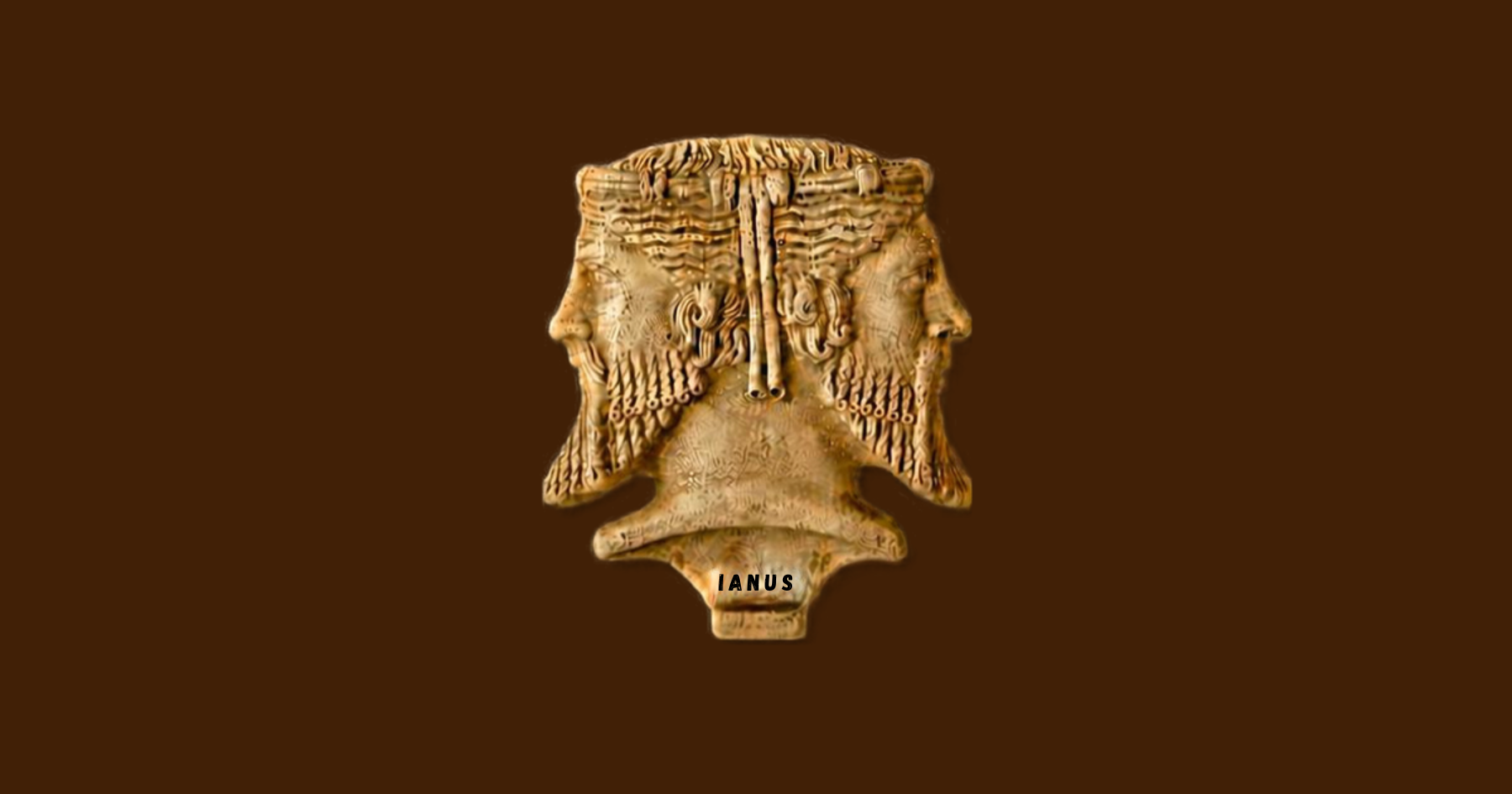
The Romans had a god for this very moment. In ancient Roman religion and myth, Janus is the god of beginnings and endings, of gates, doorways and passages, of transitions and of time. He is usually depicted with two faces. The first looks back at the road we have travelled. The second looks ahead at the place we have not yet entered. Janus belongs to neither side. He doesn't choose between past and future, but keeps both in view.
Whoever only stares at the loss looks with one gaze. Janus reminds us there is a second. Perhaps that is what he teaches us: you don't have to pretend you're not looking back, but you do need to know which face is at the wheel.
That second gaze looks towards what calls us. The voice of fear is loud; desire calls more softly, which is why we often only hear it when we consciously listen for it. Aristotle saw desire as the source of all movement. Reason alone doesn't move us, he wrote; for that, desire is needed. It pulls our lives forward. In fact, Aristotle saw desire or longing as the force that makes growth possible. That is where Janus' second gaze is turned to.
Change, then, isn't only letting go. It is shedding what no longer fits and embracing what presents itself. And once we see what presents itself on that threshold (the fear, the desire, the old role, a pattern that chafes, limiting beliefs), we can also choose between what we take with us, and what we let go of.
From what was, to what wants to become
That is also why the work we do so often can't be captured in instructions like 'apply these five steps and your team will thrive' or 'operationalise these norms and values and the resistance in the team will disappear'. However much we'd like to hand people a to-do list to tick off, this is about transformation: about deep patterns, hidden desires, inner voices and things that reach further than 'simple' behavioural change. It is also what keeps our work so fascinating, even after all these years.
Like Janus, we look both ways on that threshold. Back, with appreciation for what someone has created and built. And forward, to what the organisation and its leaders are now called to become.